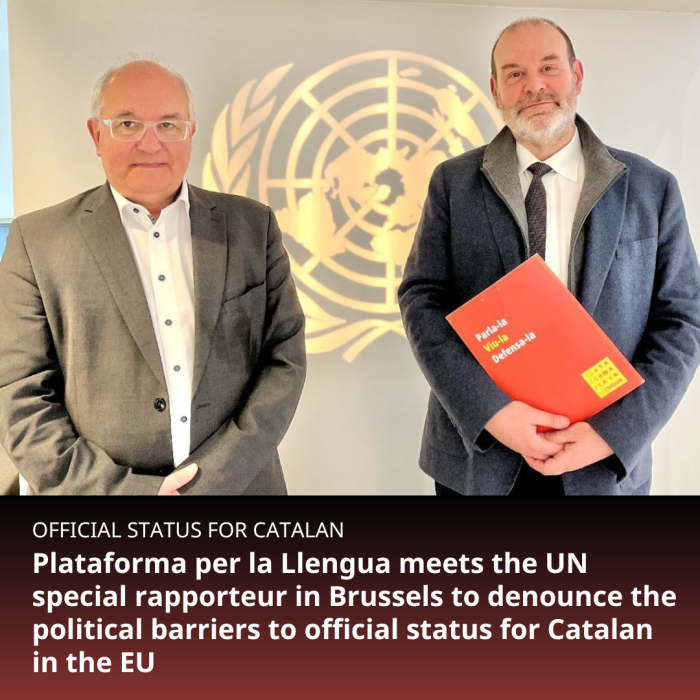


Plataforma per la Llengua has today met the UN special rapporteur for minority affairs, Nicolas Levrat, to denounce the political obstacles to the recognition of Catalan as an official European Union language, among other matters. The meeting took place at the Office of the High Commissioner for Human Rights which the UN has in Brussels as part of the rapporteur's official visit to analyse the way European institutions treat regional and minority languages.
At the meeting, the Catalan organisation's president, Òscar Escuder, passed the rapporteur documents and public statements from political leaders of the Spanish Partido Popular urging "friendly" governments to actively oppose official status for Catalan. Plataforma per la Llengua stressed that clear proof of this political pressure is the German government's change of position after a new ruling party took power in Berlin, as well as the fact that the States opposed to official status for Catalan have not provided any substantial legal, technical or economic document to justify blocking it.
The organisation also informed the rapporteur that there is no stable institutional channel within the European Parliament or in any other EU institution for the protection of regional, minority or minoritised languages. In this respect, it noted that there is no specific committee or any permanent mechanism or channel responsible for this issue. It also made clear the political obstacles to the use of Catalan within the European parliament itself, as well as the rejection of the Minority Safepack popular legislative initiative even though it collected more than 1.2 million signatures from European citizens.
The special rapporteur will publish an end-of-mission statement on 28 January with the main conclusions from his work, and the final report will be published at the end of the year.
Making use of the EU rethink to remove the obstacles to official status
Plataforma per la Llengua stresses that the rethink now occurring in Europe as a result of international instability has considerably intensified the political discussions between member States on large-scale strategic issues and their own national interests.
Plataforma per la Llengua maintains that official status for Catalan is, for many countries, much more acceptable than other proposals currently in play and that this scenario offers the Spanish government new opportunities to finally remove the obstacles to the recognition of official status for Catalan in the EU.